Latest

Field Notes #4: New York Ambiences by Michael Bates

NYAMB cover half size

In the spring of last year I went to New York with my family for a week and decided to try to get the best recordings I could whilst I was there, without annoying my family in the process!

I always take a portable recorder with me on holiday but having just got a pair of DPA 4060 omni mics and having used them to capture ambiences around London (one of which can be heard in the City Skylines theme) I knew that they handled city ambiences really well, so I was excited about trying them out in New York.

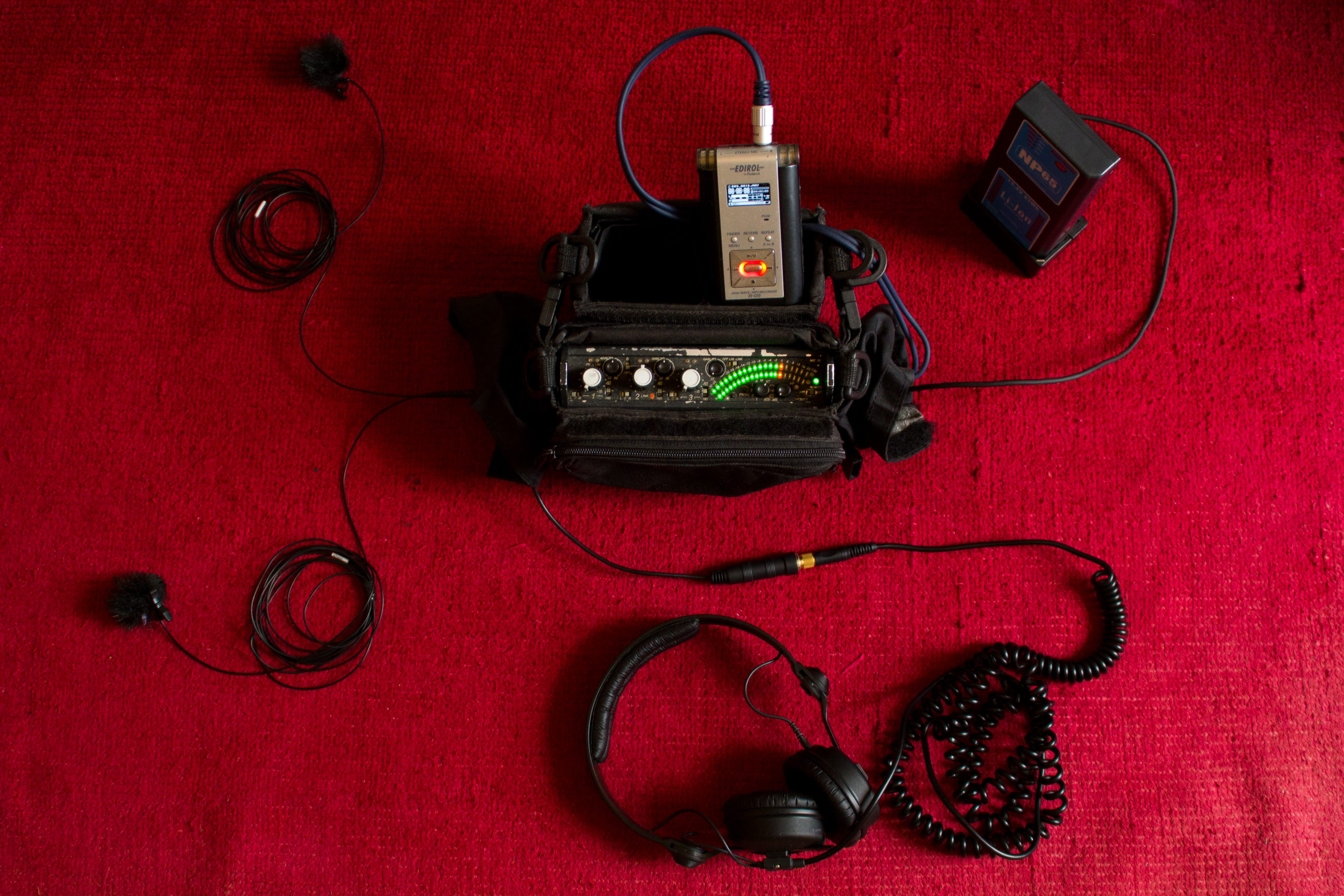
My rig is put together like this:
IMG_0001_Stealth rig laid out_half size

It comprises a pair of DPA 4060s into a Sound Devices 302 mixer which feeds an Edirol R-09 recorder. The 302 is powered by a Hawk-Woods NP65 battery, which never seems to run out, the R-09 by rechargeable AAs, which never seem to charge up. I monitor with a pair of Sennheiser HD25s.

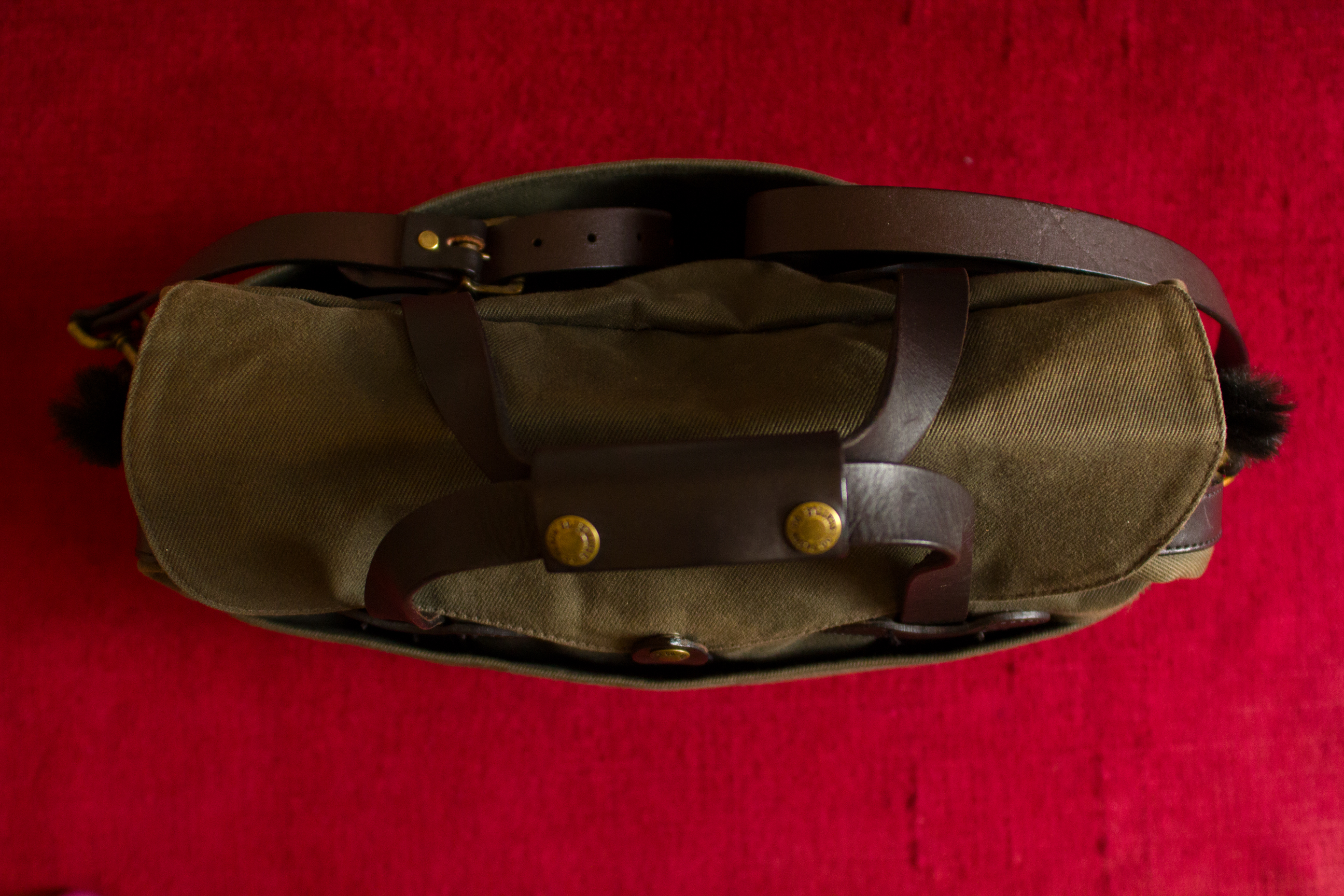
All of this fits quite neatly into my shoulder bag and with the mics clipped to the far sides of the bag I get a good 40cm spacing. Also, it’s very stealthy as all anyone sees once the flap is closed are the Rycote windjammers peeking out either side of the bag.
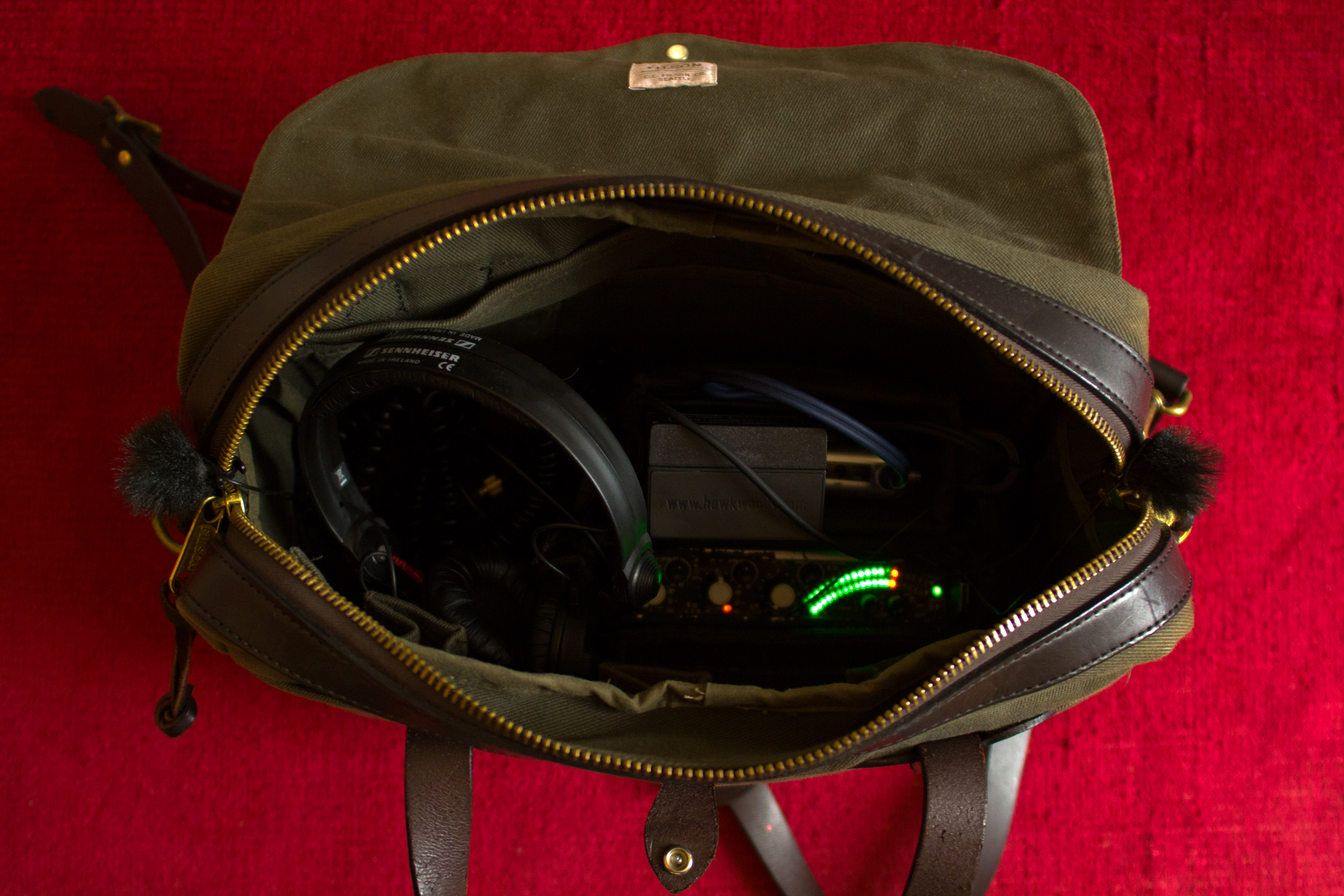
IMG_0005_Rig in bag_half size

IMG_0007_Bag closed top view_half size

Most of the recordings were made with the rig in the bag over my shoulders whilst I stood still and looked nonchalant. However, the longer Canal Street recordings were made with the mics set up outside my bedroom window in the flat we were staying in.

I was really happy with the recordings other than a few issues that I encountered, which I’ve detailed below. The 4060s have incredible low end response and lovely mid detail which really helped to capture the characteristic acoustic that New York has. Combined with the clean quality of the 302 preamps, along with its detailed metering and quality limiters, it’s a setup which does a great job of recording really dynamic things like the Canal Street traffic.

I did vacillate a little about whether to roll off some of the low end in the recordings, but in the end decided not to and to leave it up to the end user to decide how much of it they wanted to use themselves.

Here are a couple of issues that I had that made some recordings unusable and that I’ll have to solve next time I record like this:

My major issue with the setup is that in motion whilst over the shoulder, the metal clips attaching the strap to the bag click with every step and I lost some good material because of this. I could probably have gone through those recordings and taken out each click with RX, but they were so frequent and loud that I think it would have badly affected the sound quality.

There are a couple of recordings in the library that I made whilst walking slowly where this issue didn’t arise (the Staten Island Ferry terminal recordings) but I think in future I need to find a way to damp this sound or alternatively carry the bag handheld.

I lost what could have been a really good skyline recording that I made at the top of Morningside Park because I lost one of my windjammers coming out of a crowded subway and so didn’t have adequate wind protection when I got to the park some hours later. I now carry an extra pair of windjammers as backup wind protection, as those Rycote ones are none too secure and the foam covers don’t stand up to serious gusts.

The one recording that I was seriously annoyed about not getting was a beautiful skyline that I tried to record from the 7th floor balcony of the New Museum on Bowery. Unfortunately, and unsurprisingly, it’s very popular with visitors taking pictures, so instead I have a beautiful recording of people’s camera shutters clicking. If I’d been there on my own I would have stayed for as long as it took to get a clean take, but I sacrificed the recording to keep familial peace intact!

All in all I think it was a worthwhile set of recordings to make that taught me a lot about the strengths and limitations of this setup and of this style of stealth recording in particular. In the end I recorded over six and half hours of material, which I edited down to just over three hours for the library.

As a taster for club members, there’s an alternative take in the Echo Space theme of the Frick Collection Garden Court, a lovely, echoey marble hall with a fountain in the centre. There’s also a recording in the Car Passes theme of some passes on a cobbled street that I recorded whilst there.

For those club members that are interested in the library there is a discount code for 20% off on the LinkedIn group and for non club members you can get 10% off by signing up to the mailing list on tonemanufacture.com

You can see a full file list and more information at tonemanufacture.com/libraries/new-york-ambiences

I hope it turns out to be a useful library and my thanks to all the club members who share their great recordings!
New Theme for Summer 2014:

madewithOver

The club’s latest theme is chosen by club member, Rick Blything:


“I’m sure that everyone who has visited different countries and cities and pays attention to the city’s soundscape can re-call the feel and emotion from the city’s backdrop. 

I believe that vehicle horns help define a city’s soundtrack and that is what this month’s theme is all about:

Vehicle Horns: BGs

Sounds differ enormously from the near constant cacophony of horns heard in Delhi, to the slightly more constrained hoots from a tailback in an English town.

Recordings of these such sounds are great for building up scenes and can be used to good effect as both ‘off-screen’ and ‘establishing’ sounds. They can help to shape a location and sonically guide the audience to that space.

Recording techniques could range from mono directional recordings to wide stereo ambiences. Whilst recording locations could range from roof-tops, interiors, exteriors, mics out the window stlyie or straight up street level tracks. 

So next time you visit a city/town take your mics, find any one of a number of locations and pitch up, press the record button and try and capture some evocative tracks.”


Thanks for that, Rick – I can only add that, as with the dog barks theme, please bear in mind that this is a theme that is meant to provide sounds for BACKGROUNDS, not close up spot FX.  The horns need to have at least some ‘space’, i.e. echo or reverberation / ambience, around them, otherwise I’ll unfortunately have to reject them.  However, if you get a distant AND close sound then feel free to add the close sound too as sometimes these are useful to keep together.

I would suggest it’s worth getting 2-5 minutes of horns; it’s not that useful just getting one or two ‘toots’  unless they are particularly unusual or distinctive.  

As always, think about how submerged your distant horn sounds are within the roar of traffic – too much traffic noise and the horns won’t be usable because there’ll be a surge of engine roar every time your car horn is used in a tracklay.  

Lastly, as Rick touched upon in his brief, think about the space in which the horns occur – the acoustics of the space that surrounds them is what tends to make vehicle horns evocative rather than the actual horn sound itself.

As ever, I’m looking forward to hearing the results!

Field Notes #2: Texas Freight Train by Rene Coronado

train by 2

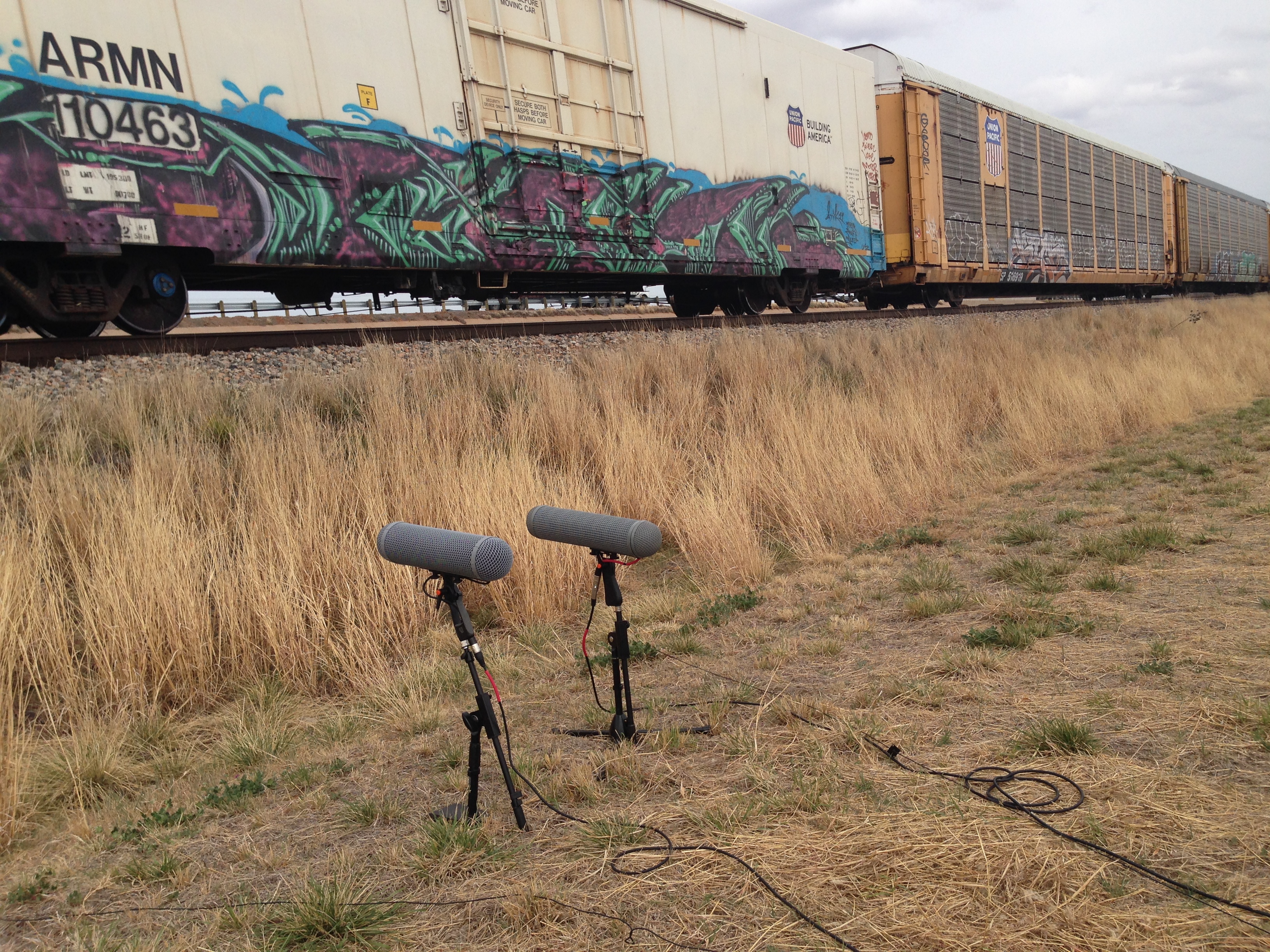
I was recently on my way back home to Dallas from visiting my alma matter in West Texas.  I always put a rig together when I travel – mostly to gather ambiences, but also to capture anything else interesting I may happen upon.  In this case I had a pair of schoeps CMC6 mics with the MK2 omni capsule, as well as a pair of Crown PZM 6d mics.

The ride back to Dallas along I-20 runs parallel to a long stretch of rail tracks, and its common to see big freight rigs crossing the state along with us.  About halfway home my wife and I spotted a train running the same direction as us, so we passed it and let it fall just out of sight of my rearview mirror before finding a place to pull over and set up.  I didn’t realize how fast that train was moving though, and by the time I got the trunk open the gates were closing and the train was already on top of me.

I closed the trunk, and we headed out again.  We caught up to the train relatively quickly, but this time I gave us a really good buffer of time to make sure I could get set and rolling without rushing.  I passed the train and kept increasing my distance for about 15 miles after passing it this second time.  When I pulled over again, I found a spot where I could cross the tracks and set up in a way that the train would pass between my rig and the highway on which I was traveling, obscuring the sounds of other passing cars.

My wife jumped out with her camera to take some rustic photos of the farm we were parked by, and my baby boy kept sleeping in the carseat while I pulled out my rig and got set up.

I placed the two omnis about 2 feet apart, and put the PZMs on the same general plane, but about 6 feet apart.  I had concerns about the omnis being phase-coherent without a jecklyn disk at that close distance because I had run some tests earlier in the trip that didn’t go as well as I had hoped – hence the PZMs, which I knew would be good for phase.  Once I was set up, rolling and slated I heard the train’s horn in the distance.  Trains are required to blow their horns at each intersection they cross that doesn’t have a gate with the clanging bells, and this train was one intersection away from me.

train setup


The train blew its horn one more time and then it was upon us – whooshing by with its crazy array of box cars, empty beds, tank cars, double decker cars, and open freight cars.  Each car had its own sound, and it created a real variety of unique dopplers as it cruised by.  Somehow the baby boy slept through all of this even though the back car door was open.

train by 1

Back in the studio I put the tracks up and was pleasantly surprised by how well the omnis did with regards to phase – even without a disk in-between.  They captured the low end perfectly and just had a remarkably clean sound all the way up.  The crowns (which I love) sounded very bite-y and midrangey in comparison, and also quite a bit “cheaper” than the schoeps omnis.  No surprise given the actual price difference, but pretty eye opening regardless.

I output three final files – an omni recording, a pzm recording, and a mixed recording that captured the best of both worlds.  Outside of gain matching, no processing was done to these files in any way.

enjoy!

train pano


New Theme for Spring 2014


95BA5CCC-EC1F-4925-8991-F383FAF3C1B1

Ever since starting the Sound Collectors’ Club, ‘Doors’ has been a frequent request whenever it’s been time to choose a new theme.  To date, I’ve always been reticent to go with it, as I feel Tim Prebble already ticked that box a while back with his epic crowdsourced ‘Doors’ collection that he orchestrated.  Although overlap with other collections is eventually inevitable, I prefer themes that don’t echo well-known independent libraries that already exist out there.

However, the thing is that a lot of people (including myself) missed out on Tim’s collection when it happened, so there is still a lot of demand from club members for new sounds in this department.  I finally caved in when club member Steve Papagiannis’ recently suggested an ‘Open & Close’ theme rather than just specifically doors, so that the theme can include all kinds of different hinged things, big and small, rather than just doors.  I’ll let Steve explain:

“How about opens and closes, building a “new” 9000 series.  Doors, drawers, gates, garages, cabinets, boxes, compartments, trunks, mason jars, etc – anything and everything, if it opens and closes, from the smallest jewelry box or door latch to the largest electrical utility box or hanger door, it’s fair game (would include knocking/pounding, latches, creaks if there are any, associated with said subject matter being recorded.”

The only requirement I’d insist upon is that you must submit the open AND close sounds of the item / object.  After that, any supplementary sounds that are useful bi-products of the opening & closing, such as creaks or the usual interior or exterior versions where relevant, are always very welcome but not essential.  Let me clarify that doors ARE welcome in this collection, but so are any other kinds of interesting-sounding hinged items too.  Oh, and obviously I’ll keep car doors in their separate collection that already exists.

So let’s do it – let’s make this the new 9000!!!


Addendums:

Rene Coronado has made a good point on Twitter regarding this theme:

“Cool theme!  I’d add:  What made Tim’s collection so good is the requirement of different performances and perspectives; i.e. soft > hard & near > far.”

& Steve Papagiannis has kindly contributed these thoughts on our subsequent approach towards labelling & metadata for this theme (and all other themes, for that matter):

“If there’s one takeway that was really successful about the 9000 Series, it was the naming choices.  Sure somebody might not care about obscure details like “Big Castle Wood Door” or “General Store Wood Door” at face-value, but these sorts of specifics actually helped search-ability (and memory recall of one’s favorites) immensely.  Hundreds of files just called “Refrigerator door open close” are not very useful in my opinion, and hard to decipher for those adding their own metadata after the fact.  Is it a steel fridge door?  Plastic/steel?  Is it more modern or maybe more of a 60s or 70s with the latches versus a traditional rubber seal?  Is it a household fridge door, or industrial (like medical or morgue)?  Is it clean and tight sounding?  or Old and busted?  Having some sort of unique descriptive “name” in the filename helps. I like to adopt the 9000 Series “Institutional” tag in my own library to mean a metal door which you might find in a commercial or insitutional structure (school, building, etc) which is that traditional, quintessential solid-panel (or maybe glass viewhole) metal door with the latch handle.  Often I like to tag my hearty, solid-sounding tasty wood doors as “Antique”, also borrowed from the 9000 series since well, we don’t make doors like that anymore and those high-quality wood doors of yesteryear have such a particular sound unlike modern household or apartment doors.  If anything, I personally think it should be a requirement that when you submit, regardless of a door or anything else like a box, please note in the filename a) what type of material(s) (or the case of something like a fridge, maybe modern or old) and b) any particular sonic characteristic (tight, heavy, thick, solid, hollow, etc) – but go by what you hear not what you see.  Countless times I run searches for solid steel door, or heavy copper door, or something like that and all I get back are dull, hollow-sounding metal doors which don’t sound like an assertive metal door I want.  I get said results as though I was searching for “hollow”.  But they get tagged as thick, solid, or heavy because of how they looked or felt when recording, not how they sound/translate.  Just some thoughts to possibly add to the page! :)”


Definitely worth bearing these thoughts in mind when collecting & labelling your sounds.


First Theme of 2014!

metal photo

Happy New Year!  As I’m sure most of you are aware, it’s been a long time since I started a new theme.  It’s been mainly due to simply being so busy over the past few months but on top of that, part of me does also like to put new themes on hold for a while from time to time so that we can give a bit more attention to existing themes that haven’t become that big a collection a yet.  I’d rather have less but bigger collections of sounds than lots of very small collections of different themes.  In this way, when members do get access to a collection it feels more of a bonanza than if you only get a couple of new sounds for your trouble.  Anyway, like I say, it’s been a while and what better time than now to kick off a new theme?  I’ve had a few suggestions for new themes over the past few months (and some of those will be appearing over the coming months) but, for now, I wanted to go with a suggestion by Rene Coronado, who has offered up ‘Metal Impacts’.  In his words, we need:

“clean, thick stereo recordings fit to be twisted into other things.  The idea being that these would be useful in designing big stylized hits and slams.  Natural reverberation is fine, multiple iterations with clean tails would be great.  Good candidates include hits on large garage doors, big metal door slams, even just straight suspended sheets of metal.  Anything big and resonant sounding.”

So I’d say this theme is an ideal candidate for using higher sample rates which lend themselves better towards pitching sounds down.  Some contact mic trickery might be fun as well perhaps?  Just a small add on my part:  If you record lots of hits, please keep them condensed to as few tracks as is appropriate /suitable.  Don’t send me loads of short files of single, similar hits, or the theme folder will get unwieldy and confusing.  Other than that, it is just what it says on the tin (pardon the pun).  As Rene mentioned, I think ‘big’ and ‘resonant’ are the keywords to remember here.

This is always a popular one with sound designers or, for that matter,anyone who likes making loud noises!  So have fun with it – I look forward to hearing the results.

Have a great 2014 everyone!

Field Notes: Spontaneous Train Recording in Dallas

Rene Coronado has kindly shared a recording he grabbed on the fly this week (members can check it out in the ‘Trains: Design’ collection).  Here are his field notes to explain in full:
I was driving home last week down my normal route which is a 4 lane street next to a highway that runs across an active rail track.  I noticed that a bus was stopped at the intersection even though the light was green, and then a split second later I realized that the train crossing gate was coming down.  I zoomed up to the crossing in my car and stopped as quickly as I could, and then I looked left.  Sure enough, a giant freight train was approaching less than 50 meters away.
Time seemed to slow a bit, but I kept my head about me and did the following in about 5 seconds:
 – put the car in park
 – turn off the radio (I forgot to turn off AC)
 – roll down the window
 – reach beside me and grab my PCM M10 from the passenger seat
 – switch the button from hold to on (I never power this device down, I just put it in hold mode)
 – hit record
 – hit play (always important)
 – adjust the volume way down (metering ambient noise just barely)
 – hold the device out the window
Its actually a fair amount to get exactly right in that short of a period of time, but I managed to do it and just barely caught the horn as it began to blow.  The train gave me a nice full blast right as it entered the intersection 10 feet in front of my car and I managed to capture it without clipping anything.
Once the horn was by I just popped the recorder up on the roof of my car and let it roll while the train continued passing.  By then other traffic had pulled up and stopped around me and the bus as well.
When the train was all the way by I let roll as long as I could, then the gate went up, I grabbed my recorder, rolled up my window, kicked the radio back on and kept on driving.  🙂
Here are the few things I learned from this:
 – I can get from zero to rolling in about 5 seconds if my tools are set up around me well.
 – The PCM 10 even in high gain mode can record incredibly loud sounds without clipping.  Mics may have clipped a bit, but its really difficult to tell if that was them or just the air ripping around.
 – Even in traffic next to a highway with very ambient omni mics I can get a really good recording of a loud enough sound
 – The built in wind protection and always on battery management of the PCM M10 are incredible
 – this recording wouldn’t have happened with a PCM D50 (wind protection) or a zoom H4n (wind protection + startup time)
 – that train didn’t doppler very much, as it wasn’t traveling exceptionally fast
enjoy!
-Rene

First New Theme for 2013-14

3D2AD457-FEEA-4CDF-AFC8-789EA16647A1

It’s been a long time coming but finally I bring you the first new theme of the 2013-14 season!

I was going to go with a member’s recent suggestion, or a more summer-influenced theme this month but then I got inspired by a new editing / sound design technique I picked up from Douglas Murray on the Designing Sound website the other week, which led me to thinking of applying it to our latest theme.

As you’ll see from the link, the tip shows you how to create endless fill, or tone, from a tiny sample of an original recording.  As a post sound dialogue editor this technique is a lifesaver for when you’re struggling to find clean bits of ‘air’ from sync sound to connect lines of dialogue together in a scene.  However, Douglas also mentions he uses it for sound design tasks too, which got me to thinking how it could be useful to bear this trick in mind as we collect our room tone recordings.

Basically, I primarily want us to build up a standard collection of room tones as you’d expect:  I’d say anything between a minute and a half to five minutes is a sufficient duration.  Recordings need to be neutral, in the same way as was required for the City Skylines collection – this is the indoor equivalent.  No bumps, bangs, voices, car horns, etc – just neutral indoor air to be used as a sound bed in a scene.  There can be a sense of distant traffic but once again, as with the City Skylines collection, it must be a wash rather than contain any specific vehicle details.  Level-wise, bear in mind what volume these recordings will be used at – you don’t want to have to pull the volume down loads on the recording every time you use it, but you also don’t want to have to boost it loads either.  Think about the volume it plays back at when played at unity.  Ideally, when prepping a scene, I like to have to pull atmos beds like room tone down by about 5-10 dB from their recorded level.

Other than that, all I can add is – be as adventurous or as unimaginative as you like!  If you can get recordings of unusual spaces then that is fantastic but even if you just get a recording of your living room, bathroom or kitchen then that’s still really useful – all spaces vary slightly in character plus the particular  way you record it will give it it’s own feel too (e.g. wider or narrower stereo image, closer to the window, etc. plus everyone’s own ‘outside world’ inevitably influences the indoor tone even when it’s very quiet).

I’ll re-emphasize an important point though:  make sure your room tones are quiet!  No-one wants to have to go through tracks editing out bumps and bangs, tap drips, car passes, etc. – make sure these recordings are nice and clean!  I’ll also add that this is not the ideal theme to use handheld recorders or cheaper equipment for, due to the inherent hiss that will be likely to show up in these quieter recordings.

Now for the twist:  many times I’ve been recording in an interesting building (or in underground spaces, or quite busy places, for example) and got all kinds of interesting short sounds but often, for one reason or another (such as you’re not really meant to be recording there!), I’ve simply not been able to get more than about 5-10 seconds of clean room tone, so I end up not bothering because 5-10 seconds of tone is a bit of a pain to try and use as an atmos bed in a scene.  However, Douglas’ great trick opens up the possibility of now making use of these short snippets of sound to create endless tone from them.  Therefore, I’m suggesting, as a subfolder within this collection, that we have a collection pot for any snippets or scraps of room tone from interesting spaces that you’ve recorded in but only managed to get short recordings of clean tone from.  By sharing these, we hopefully will also have a folder of bits ‘n’ bobs that we can create endless other room tones from.  I don’t normally let the club stray into the field of sound design, but this method of room tone creation is so dependant on it’s original source material that I thought it was worth starting a sub-collection of our field recordings to support it’s practice.

Please read Douglas’ article carefully though please – he gives a very thorough description of how to make this technique work best.  Please don’t share tiny 1 frame or 1 second samples – I would say that anything between 5 to 30 seconds is most appropriate.  As Douglas explains, the slightest movement or change in sound  creates a different tone so give enough of the recording to enable others to choose which fraction of it works best.

Important point:  you can only contribute to this ‘snippets pot’ if you’ve contributed a standard, long duration room tone recording to the collection.  This ‘twist’ to the collection is simply a fun add-on, not the main focus of the collection – it may not even really work out, in which case I’ll ditch the idea, but I thought it was worth experimenting with.

Any thoughts or suggestions below – now, let’s get back to collecting!  Thank you all for your patience while new themes have been put on hold while I’ve been digging myself out of the admin hell that was switching cloud servers from Sugarsync to Google Drive – hopefully that hard work will be worth it in the long run.

All the best,

Michael

Field Notes: Uncertain, TX

Wind Howling Through Swampland, Uncertain, TX_KyleHughes

I received a contribution to the ‘Wind’ collection recently from club member, Kyle Hughes.  It was called ‘Wind Howling Through Swampland, Uncertain, TX.  Now, to Americans this is perhaps not that out of the ordinary, but as an Englishman, I was fascinated by the name of this place and that it seemed very remote – and a little eerie!  Anyway, something I want to do more of this year is try and get members to write a little bit about their recordings when something out of the ordinary catches my ear or eye – Field Notes, if you will.  In this case, Kyle kindly agreed to tell us a bit more about Uncertain, TX.

Hi, Michael asked me to follow up on a recent upload to the ‘Wind’ collection. The reason is that it was recorded in such a remote location; i.e., the swampland of Uncertain, TX, USA.

I went out there to record for a short film in Winter/Spring of 2011, and visited a state park, as well as some local fishing holes. I am from Dallas, TX, and travelled out to Uncertain to shoot on Caddo Lake, at the border of Texas and Louisiana. The swampland is full of cypress trees and the infamous American alligator.

It’s funny- on the drive East, there is a point at which the landscape changes- the trees are all tall pines; it’s like a dividing line.

One night, a few crew members and myself ventured out to a dock on a small pond surrounded by a thick forest of trees. The trees are always covered in a great deal of moss that hangs from the branches, and in the winter it’s all brown and dry. I decided to record because of the howl that the wind made- we were surrounded by trees, but there was open air over our heads. In the distance, I could hear some strange sounds- cars driving over cattle guards, maybe, as well as a distant train blast.

The DP for the film compiled some extra footage into a short web video, which can be seen at the link below. None of the locations depicted are exactly where the wind track was recorded, but you can imagine what it looks like, based on what is seen:

http://vimeo.com/26854736

If anyone is interested in seeing the actual short film, you can contact me and I’ll share a private link. It was a student film, but it did have some moderate success, traveling around the world. As far as equipment, it was shot with an ARRI SR3 on Super 16mm film, and all audio was recorded into Sound Devices 702′s, primarily using the Sennheiser ME66.

It is a fascinating place. I find it as intimidating as it is relaxing- welcoming, yet unwelcoming by the twisted natural beauty that comprises it. There are no tourist attractions besides the humble, local diner and twice-a-month flea market. In spring, the colors turn to green and the birds and gators come out. I’ve heard that the town “Uncertain” was given its name because the line dividing Texas and Louisiana was unclear, due to the widespread swamp-lake.

That’s about it- if you’re from the states it may be nothing new, but it’s even quite different from where I live, just a couple hundred miles away. Worth a visit, I’d say.
Kyle Hughes

Last Theme of 2012-13 Season

tools logo

The last theme for this season has been chosen by Jennifer Lewis, from Vancouver, who joined the club recently.  When Jenn joined, she suggested starting a page within The Knowledge where members can make suggestions for future themes.  She immediately added a few of her own ideas to this page, so I was more than happy to let her pick one of them this month.  Over to Jenn, to introduce herself and her theme:
“Greetings all, I’ve been working with sound for 30+ years.  My experiences range from linear to non-linear; sound design, dialog and music, production thru post.  The last 18 years have been focussed on audio for games and I’ve been fortunate to be involved with some amazing projects and people.  I recently bought a bunch of field gear and am re-broadening my explorations with recording adventuring.  A ‘back to roots’ of sorts.
 
Theme blurb:
Tools – an Unexpected Journey.
My dad was a carpenter. As a kid, I’d hang out in the shed and would play with vices, hammers, jars of nails, screwdrivers and chunks of wood, etc.  Fascination, for all the senses.  I don’t know about you but I have always wanted to schmooze my (and my recording gear’s) way into a big hardware store, while it’s closed. 
 
While the club’s theme descriptions tend to be quite specific, I invite you to explore the most unusual sounds that can be found in your tool drawer.  For me, it’ll be about the curious use of a given tool, as well as a unique space and recording perspective.  “Play” with the object and hone in on the unexpected.  Perhaps: use a vice clamp under water in your sink.  Or, roll a screw around in a bottle.  You could, turn a screw into a turnip with contact mics on it!  Why not? Who knows what you’ll end up with!”
So, rather than simply collecting literal sounds, we need to use tools as a starting point for interesting sound creation.  A wide variety of outcomes are possible, though I’d imagine an element of friction or impact will be common to most of them.  Rhythmic?  Mechanical?  Organic?  See what you can come up with – it’ll be interesting to see how many tools are actually recognisable in the sounds.  Do mention the name of the tool that you use and include a picture whenever possible; that might be particularly handy for this theme.
Just to be clear – no signal processing should take place.  This is about imaginative use of props, locations, mics and recording techniques to get interesting new sounds.  This is a bit more of an open-ended brief this month, so do shout out below or e-mail me if you aren’t sure of anything or have any questions.